Israel rushing to make its West Bank land grab permanent
'They want the land without its people'
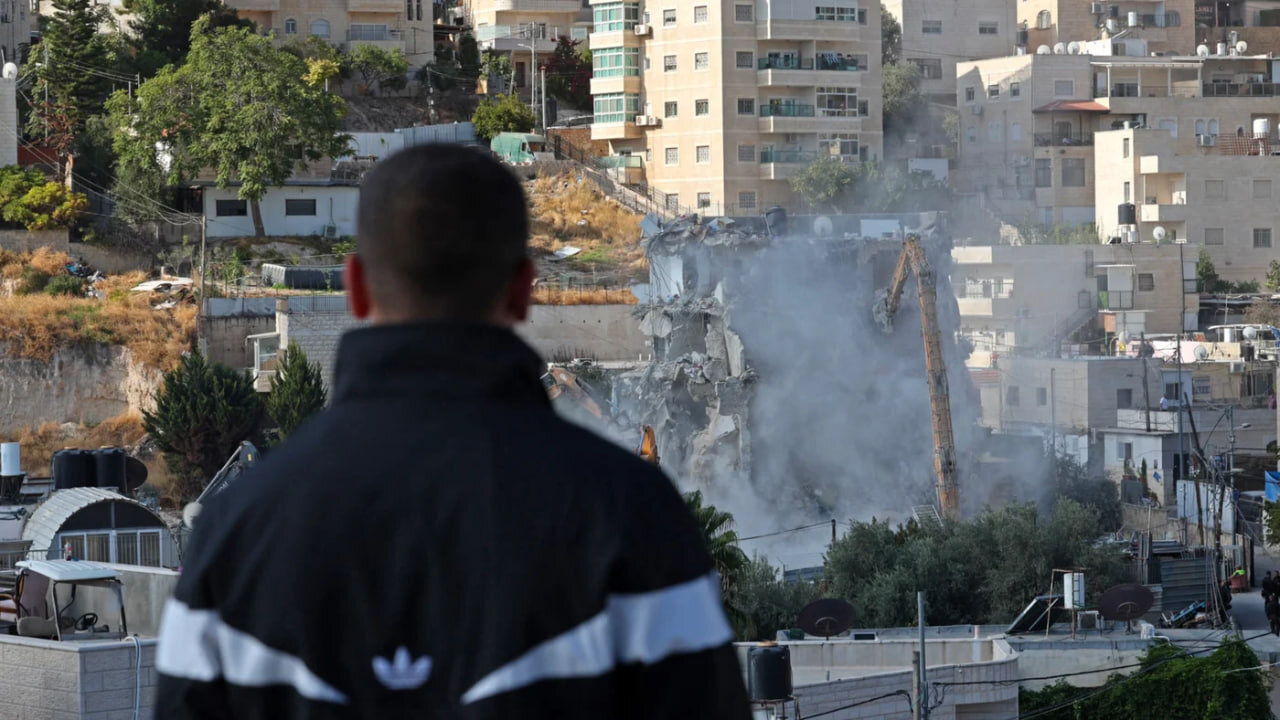
TEHRAN — Itamar Ben-Gvir climbed onto a bulldozer in occupied East al-Quds (Jerusalem) on Tuesday. Beneath him lay the ruins of a five-story apartment building. Ten apartments, home to roughly 70 Palestinians, mostly women and children, were reduced to rubble in the al-Tur neighborhood.
Israel's national security minister arrived under heavy police escort, three weeks before the Oct. 27 election, to personally oversee the destruction.
The building belonged to Mustafa Abu Subaitan. Residents received their final eviction notice on Monday following years of fines and denied building permits.
The United Nations notes that obtaining these permits is nearly impossible for Palestinians in the city.
The al-Quds (Jerusalem) Governorate described Ben-Gvir's participation as electoral exploitation. Hamas condemned it as organized terrorism.
Between July and September, the governorate recorded 139 demolition and land-clearing operations. Officials logged another 150 eviction and property-seizure notices.
UN data indicates approximately 170 Palestinian structures have been destroyed in East al-Quds (Jerusalem) since January.
Across the wider West Bank, Palestinian officials recorded 341 demolition operations targeting 740 structures in the first half of 2026.
Near Hebron on Monday, bulldozers leveled a home in Khallet al-Deirat in 25 minutes, leaving two families homeless.
The International Court of Justice ruled in July 2024 that Israel's presence in the occupied territories is unlawful and demanded settler evacuation.
‘Settlement revolution’
Between 2013 and 2022, Israel approved three settlements. Since then, the government has approved more than 100. 34 were authorized in a single March cabinet session.
Outposts erected in violation of Israeli law have received retroactive state authorization.
Military chief of staff Eyal Zamir reportedly warned the cabinet that the military was severely overstretched. The cabinet approved the settlements anyway.
Finance Minister Bezalel Smotrich inaugurated two new settlements on Sept. 27. Smotrich called it a continuation of the "settlement revolution" designed to prevent a Palestinian state.
The government is pushing forward a tender for E1 before election day. E1 is a highly contested plan that would drive a physical wedge of housing between East al-Quds (Jerusalem) and the interior West Bank.
Smotrich stated openly that the objective of E1 is to bury the idea of Palestinian statehood.
War Minister Israel Katz announced a target of one million Israeli settlers in northern West Bank during the August reopening of Ganim. In 2005, Israel evacuated Ganim, Kadim, Sa-Nur, and Homesh.
All four northern West Bank settlements are now reoccupied. Settler families moved into caravan homes in Sa-Nur under military guard.
The estimated settler population now exceeds 540,000, living among roughly three million Palestinians.
‘They want the land without its people’
The physical restructuring is most visible in the north. In July, the army issued 15 land confiscation orders covering roughly 200 dunams in the Jenin governorate.
The orders target land in Areas A and C to clear a bypass road connecting the new settlements of Emek Dotan and Noa.
This is the first time since the Oslo Accords that military seizure orders in Area A serve explicit civilian settlement infrastructure rather than a military cover.
Six new military camps have been established across Jenin. Dror Etkes of Kerem Navot called the operation a comprehensive land-grab machine. Settlers and state forces work together to break the contiguity of the rural Jenin region.
Palestinian communities face total isolation. In Abu al-Sharqiyah, east of Jenin, 26 businesses received demolition notices in August. Mayor Burhan al-Azamtah said the village is now surrounded like a prison.
In nearby Arrabah, the Israeli military has uprooted trees and restricted agricultural access. Mayor Ahmad al-Ardah said the objective is clear. "They want the land without its people," he said.
Near Sa-Nur, settlers forced the Asa'asah family to exhume the freshly buried body of their 85-year-old father. The settlers claimed the grave was too close to the settlement. The family reburied him in another town.
Olive harvest and 'Herod's Pool'
This autumn, the olive harvest opened under fire.
Settlers attacked a family harvesting trees at Jabal Qamas on Oct. 3. Hussam Adily was left in critical condition.
The attackers then entered the village of Osarin, ransacking a home and smashing vehicles.
Similar violence struck Rantis, Sebastia, Beit Imrin, Deir Sharaf, Aqraba, and Arrabuna. Farmers were beaten, pepper-sprayed, and run over.
Near Abu Dis, settlers burned about 55 olive trees. In Sinjil, Rafat, and Kafr Ra'i, settlers stole olives and ladders.
In Fasayil, settlers diverted irrigation pipelines from farmland owned by Saad Nemer to fill an ancient reservoir.
Smotrich announced funding to develop the site as "Herod's Pool," and Nemer's crops dried up.
In Taybeh, the West Bank's last entirely Christian village, the military declared the area a closed military zone. The order blocks Palestinians from their groves while settlers roam freely.
Lethal force accompanies the harvest violence. In Yasouf on Oct. 1, settlers shot dead 51-year-old Mashhour Yassin.
The Palestinian Foreign Ministry reported that soldiers threw away the keys to the responding ambulance. On Oct. 2, 19-year-old Bahaa al-Natsheh was shot dead near Kobar.
On Monday near Bani Naim, troops fired on a vehicle, killing 38-year-old Hossam Alaa al-Din Abdul Jabbar Walad Ali. The army claimed the car attempted a ramming.
'That is not my job'
Journalists documenting the violence are active targets. On Tuesday near Aqraba, armed settlers beat Agence France-Presse photographer Jaafar Ashtiyeh with gun butts.
They fired live rounds and stole his equipment. Around a dozen Israeli soldiers stood 500 meters away. They made no attempt to intervene. AFP global news director Phil Chetwynd called the attack unacceptable.
The daily intimidation is relentless. Near Taybeh, settlers from an illegal outpost ride donkeys to the Kaabnah family home every morning and evening. They throw rocks and rattle the property fence. Volunteers sleep on the floor in protective presence shifts.
The Palestinian Colonization and Wall Resistance Commission recorded 14,742 attacks by forces and settlers since October 2023.
These attacks have killed 66 Palestinians and damaged more than 147,000 trees. Over 100,000 of those were olive trees.
On Monday, soldiers bulldozed a memorial to slain students inside Birzeit University and detained 12 people across the West Bank. Roughly 9,350 Palestinians sit in Israeli prisons today.
The United States provides no restraint. Donald Trump lifted Biden-era sanctions against violent settler groups on his first day back in office.
Britain banned settlement goods last month, with Foreign Secretary Ed Miliband calling settler violence ethnic cleansing. Prime Minister Benjamin Netanyahu denounced "a handful of rioters" but immediately told settlers the land was theirs.
The regime apparatus functions as intended. Near Taybeh, an Israeli border police officer threatened to arrest a Washington Post photographer. Asked why he would not instead arrest a settler throwing rocks at a family, the officer answered: “That is not my job."
Leave a Comment